
For the past many months, my husband and I have received direct mail appeals from several nonprofits that we’ve supported over the years. These letters have been slightly different from past solicitations. In addition to the anticipated updates on organizational activities as a prelude to seeking renewed donations, they entreat us to join their legacy societies by making a planned gift. Clearly, the nonprofits have determined that we’ve arrived at an age when such requests are appropriate. The fundraiser in me thinks, Sure, this makes sense, while the human in me thinks, Hmmm, is this a bit presumptuous?
I’ve saved the various letters to analyze their approaches. Some insert a planned giving response form into the annual fund appeal with no explanation. Others send letters discussing the importance of endowment building for institutional sustainability and include information on planned giving. Still others get right to the point and make a pitch about leaving a legacy, with a handy how-to giving guide for charitable bequests.
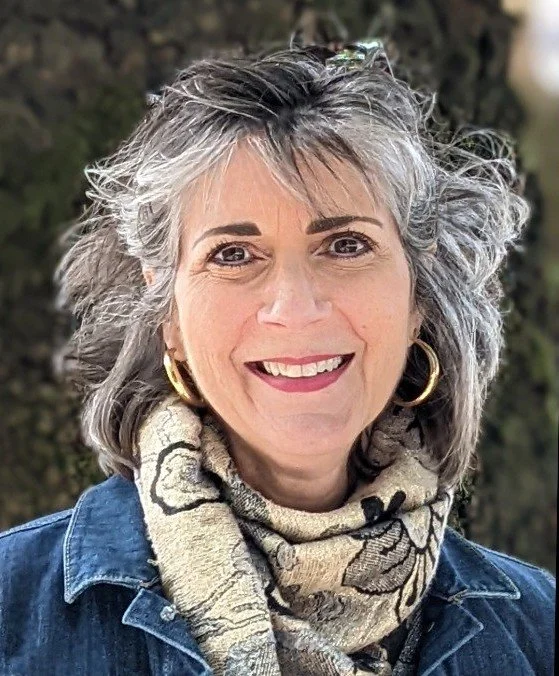
I reached out to my friend and colleague, Jackie W. Franey, a Charitable Gift Planner Hall of Famer and expert in planned giving and non-cash assets fundraising. I wanted to discuss how best to engage annual fund donor prospects in planned giving. For 30+ years, Jackie has successfully led major and planned giving efforts at notable organizations, including the American Heart Association, Communities Foundation of Texas, and The Nature Conservancy, and now runs her own consultancy. Below is an edited transcript of our conversation.
AB: Jackie, thanks so much for talking with me today! We’ve all heard for years now about the “great wealth transfer” of the Baby Boom generation. Coupled with the decrease in federal funding that has negatively rippled throughout the nonprofit sector, it’s not surprising that organizations are turning to planned giving as another source of contributed revenue. What do you make of my recent cache of mail?
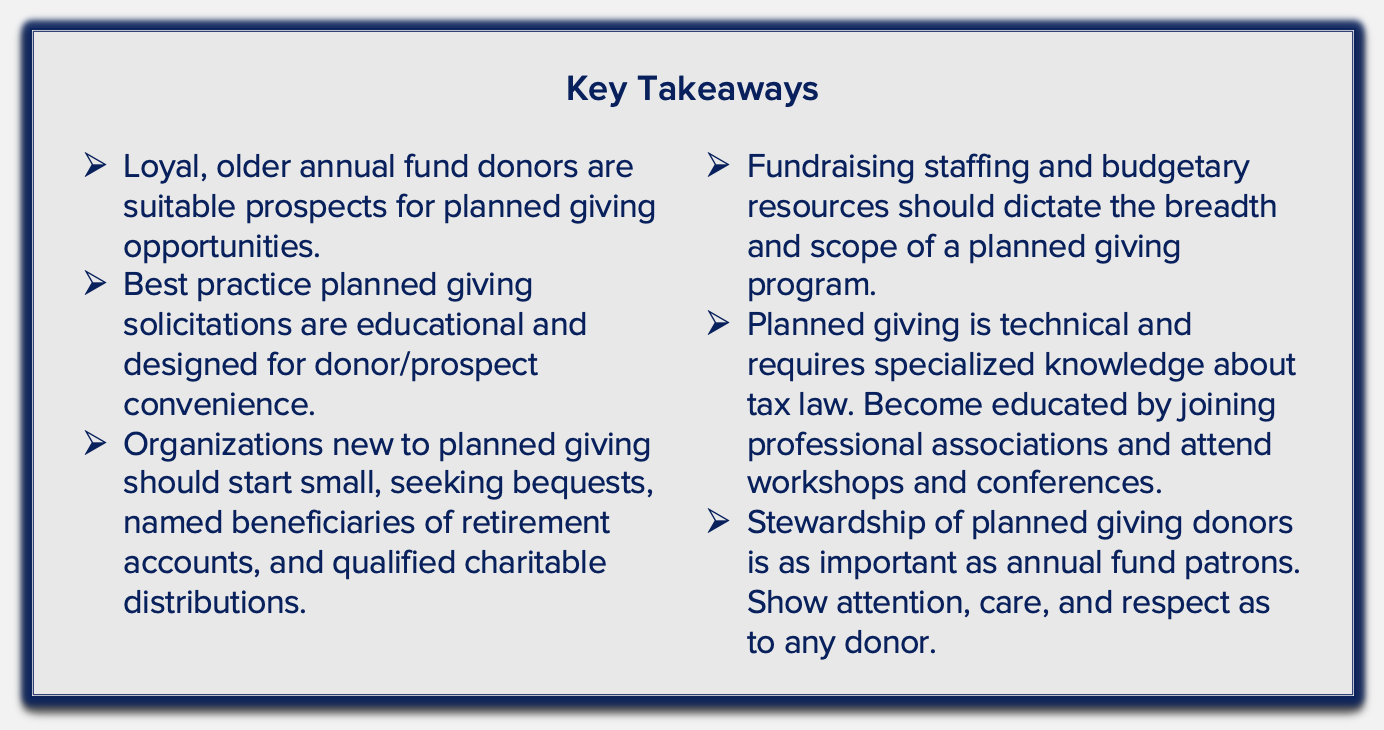
JF: This all makes good sense to me. You’ve been giving to these organizations for a long time, so they’ve likely run some analytics and determined that a logical next step for you could be planned giving. Today’s planned giving appeals are educational and designed for donor convenience. The “how-to” materials that you’ve received are intended to share options for your personal philanthropy and make your giving as easy and seamless as possible.
AB: Thanks for that reframing—it’s helpful for me to think of these gestures as useful and providing opportunities to loyal donors like me for future giving. What’s your advice to nonprofits who are seeking to start a planned giving program?
JF: First, think about how much time and resources your organization can devote to a planned giving program. Are you a fundraising team of one or two generalists wearing multiple hats with a limited fundraising budget? Or is your development program substantial, with major and planned giving officers who can devote real time to planned giving? Then determine how to best utilize your resources.
If you’re a small or mid-sized team, I recommend starting with the basics, focusing on your website and targeted mailings to solicit revocable gifts, which are usually the largest percentage of gifts in a planned giving program. These include charitable bequests, retirement plan and life insurance beneficiary designations, and qualified charitable distributions (QCDs) from retirement accounts for those with required minimum distributions (RMDs). The law incentivizes this kind of philanthropy and enables individuals to make charitable gifts to nonprofits that transfer prior to or upon death.
AB: Can you walk through how you would approach getting started?
JF: Of course! Once you determine the kinds of planned gifts your organization can accept, the first step is to update your website with planned giving information so it’s readily available to your donors. Include your organization’s legal name, mailing address, types of gifts accepted, and how to contact your staff. Provide instructions on how to include your organization in a will, how to name your nonprofit as a beneficiary of a retirement plan, and how to make a stock transfer or give from a donor advised fund (DAF). Good examples can be found on the websites of a regional community foundation, university, or hospital. Here’s the planned giving webpage for The Nature Conservancy, where I last worked, which has a sophisticated program.
Use your organization’s e-newsletter to share information, referencing your planned giving landing webpage. If your fundraising team has more capacity for outreach, then develop some general planned giving materials—a well-written one-pager outlining the deferred giving options with a reply form and envelope, plus a cover letter minus legalese that can be personalized. Include stories by recent legacy donors, which can have a real impact on encouraging others to give.
Now turn to your donor database. Run a sort to identify individuals who have been giving to your organization for a long time, 10 years or more. Let’s say this generates a list of 1,000 donors but you can only afford to mail to 500 of them. Prioritize those who are aged 70-plus or who are located geographically close to your office so you can visit with them in person. Or do a sampler mailing to every other name on the list for a more realistic response rate. Fine tune your cover letters accordingly and be sure to include information on how to make a charitable bequest or designate a nonprofit as a retirement plan beneficiary. Through experience I’ve learned that most planned giving programs realize 80-85 percent of their gifts this way. Beneficiary designations of retirement plans are especially advantageous because they don’t require an attorney to complete the form and many people do not want to pay to create or update a will.
AB: How often should a small shop circulate materials?
JF: Depending on time and budget, plan to send one or two mailings like this a year. You may not get a big response but be ready to reply within 24 hours to anyone who does react, which means planning the mailing when you’ll have time for follow up. If there’s no immediate response, don’t worry. Flag the donors who received mailings and when they make another annual fund gift, call to thank them. During these conversations, inquire about their potential interest in planned giving. This kind of direct outreach also gives you the opportunity to talk to donors about DAFs or gifts of appreciated securities.
AB: Can you explain RMDs and QCDs?
JF: Required Minimum Distributions, or RMDs, are IRS-mandated minimum amounts that owners of tax-deferred retirement accounts must withdraw annually, based on their age (beginning at age 73 or 75) and life expectancy. Donors who don’t need their full RMD for living expenses and who are looking to minimize their taxable income or prevent increases in their Medicare premiums can contribute all or part of an RMD to charity. For 2026, the amount is $110,000 per person per year; this usually changes every year. Donors won’t receive a tax deduction for these gifts, but they won’t pay any tax on the donated amount, either. This direct transfer of funds from a qualified IRA to a nonprofit is called a Qualified Charitable Distribution, or QCD.
Don’t assume that donors know about QCDs as a giving option. It’s a great way for some donors to make major gifts to organizations they’ve supported for years. And it’s important to ask your donors to alert you when they’ve made a QCD so you can acknowledge their generosity. Retirement asset custodians like Fidelity and Schwab typically don’t put their names on the check and you won’t know who the donor is otherwise.
AB: There are a lot of legal and technical aspects to legacy fundraising, with all kinds of tax implications. What resources are available for fundraisers to increase their knowledge and skill in planned giving?
JF: The National Association of Charitable Gifts Planners (CGP) is the leading organization for planned giving professionals. For those interested in becoming proficient in planned giving and learning about the full suite of planned giving instruments, like charitable annuities and charitable remainder trusts, I recommend joining CGP and begin networking with peers. Every state has a council that holds monthly or quarterly meetings and events. Attend the annual conference, which is held every October. Or enroll in The Fund Raising School at Indiana University’s Lilly Family School of Philanthropy (where we both teach) to earn a certificate in planned giving. Become a member of the Association of Fundraising Professionals, which offers workshops on planned giving at chapter meetings and annual conferences.
And keep learning on your own. Visit the planned giving webpages of large nonprofits, like the University of North Carolina near me, and look at their materials. Peruse the website of Prof. Russell James III, PhD—he is a rock star in the planned giving community and he’s made his academic research open and accessible to everyone. Here’s his video on how to launch a planned giving program.
AB: How terrific there are so many educational options! What’s your counsel to me about the nonprofits that have solicited my husband and me for planned gifts? I’ll admit that the letters have nudged us to update our wills and estate plans. Should I follow up with those we intend to help or leave that to our attorney?
JF: This is personal preference. If a donor calls an organization to say, “I’ve put you in my estate plans”, fundraisers will want to learn as much as possible about that gift. They may call or want to visit, or they may send a bequest intention form. Some donors are private and don’t want to share much information. Those who prefer discretion can inform an organization about their gift intentions but indicate they don’t want to fill out any paperwork or receive any future mailings about legacy giving. They shouldn’t be surprised, though, if an individual giving officer checks in now and then!
My advice to fundraisers is to listen to your donors and meet them where they are. If a donor indicates that she’s named your nonprofit in her estate plans, ask, “How did you make the decision to include our organization?” And then follow up with, “Would you feel comfortable sharing any details with me?” Respect what she reveals and don’t be pushy. Our natural inclination as development officers is to seek detailed information about the gift. And most organizations want to count every planned gift, especially the dollar amount. Sometimes I think nonprofits put too much pressure on fundraisers, causing them to potentially compromise the donor-fundraiser relationship. Remember that most planned gifts are revocable, so always treat your donors with care, and don’t press them for information beyond what they want to divulge.
AB: It’s clear from our conversation that investing in planned giving delivers meaningful impact for organizations and their donors. Do you have any last words of wisdom to share?
JF: I’ll repeat myself and say again to start small. You can always build the program over time. Better to do that than have grand plans that you can never implement. In summary, I’d emphasize these five things:
Define the amount of time and budget you can spend on planned giving.
Focus initially on the easy types of planned gifts, such as bequests, retirement plans, and QCDs.
Institute a system for marketing your planned giving program through your website, e-newsletter, and periodic mailings.
Start with donors who already love you to have general conversations about planned giving—loyal donors like you who have been contributing for a long time, plus donors of a certain age (late 60s and early 70s).
Sensitively steward your donors and don’t forget about them once they’ve joined your legacy society. A longitudinal study on health and retirement by the University of Michigan has shown that donors are still making philanthropy decisions towards the end of their lives, so keep them informed and engaged with your organization and its impact.
AB: It’s always a delight talking with you, Jackie. For readers who seek expert counsel on planned giving, feel free to reach out to Jackie Franey here. And if you need a tune up on your direct mail letters or an analysis of your overall development program to include planned giving, contact ABCC here.
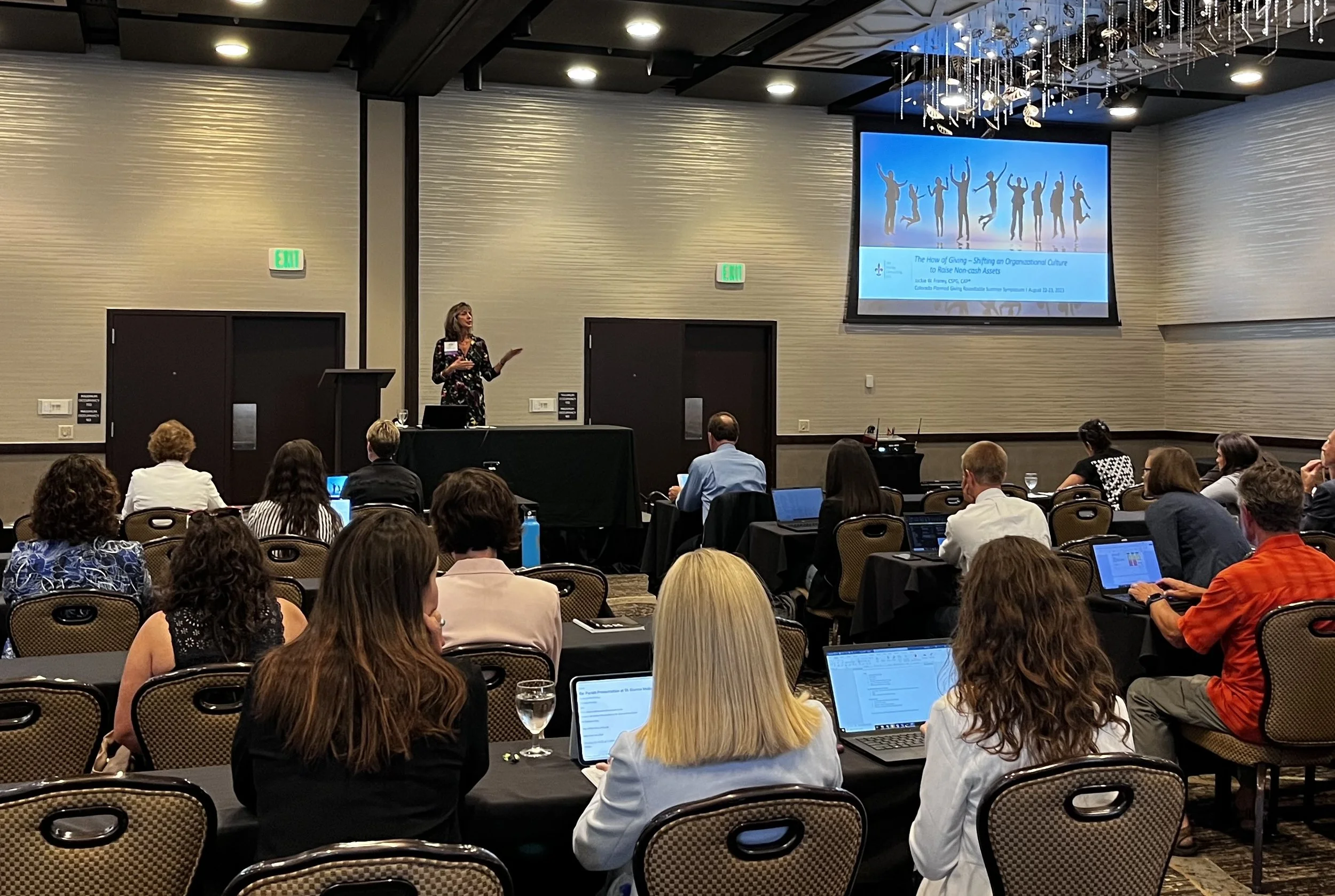
Image credits: Jackie Franey portrait. Jackie Franey presenting at the Colorado Planned Giving Roundtable Summer Symposium. Both courtesy of Jackie W. Franey.