
Roadmapping: Fundraising Planning for Nonprofits, Part 2
My prior post, found here, introduces the concept of a written annual fundraising plan as a forward-focused roadmap for the development program. Such a plan promotes team engagement, aligned and integrated activities, and the best use of limited personnel and other resources. Let’s explore what this roadmap should include.
For illustration purposes, I’ve based this example on a mid-sized nonprofit with a six-member advancement team, comprising four frontline fundraisers, a database manager, and one administrator, aided by the organization’s marketing staff, finance staff, and a special events consultant. To create your plan, address each donor source separately, articulating the fiscal year-end goal, identifying primary prospects, outlining the overall strategy and schedule, and noting who is responsible for execution. Since every organization is different, I’ve included some questions development staff might ask themselves to guide plan preparation. This approach is scalable to organizational capacity and works equally well for both small and large teams.
Executive Summary
Write this section once you’ve gathered the relevant data from all donor categories. Summarize fundraising priorities, opportunities, and goals for the year. How much general operating support (GOS) can realistically be raised? Are there new projects or programs soon to launch that require underwriting? What about capital projects and endowment building? Capture fundraising priorities in narrative or bulleted form, and provide credible explanations for any significant increases or decreases in funding from the previous year.
Organize collective goals in an at-a-glance chart that summarizes the plan’s intent in comparison to the prior year, something like this:
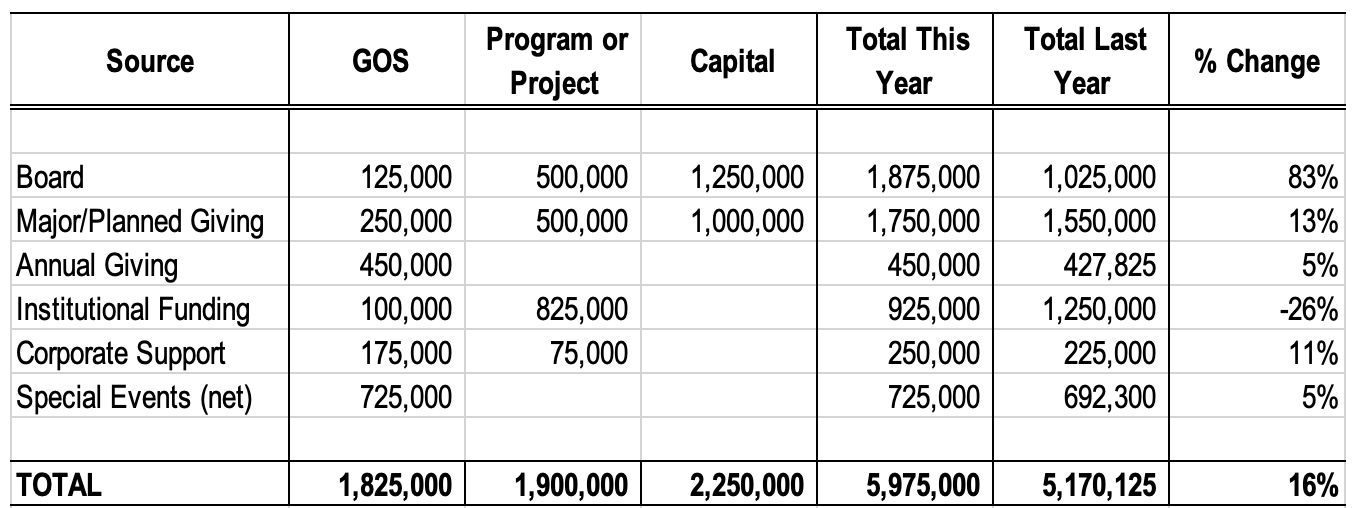
You can also craft a spreadsheet that more directly corresponds to your nonprofit’s financial reports. Now let’s consider the categories for board giving, as well as major and planned gifts.
Board Giving
Your board members are the most visible symbol of organizational governance, stewardship, advocacy, and engagement. Their leadership in philanthropy paves the way for community participation.
Are there expressed expectations for board giving, including 100 percent participation? If not, is there opportunity to encourage this intention with your CEO and board leadership? What was raised last year and what is the overall board goal this year? Do the board and development chairs join the CEO and/or chief development officer (CDO) in seeking personally meaningful commitments from each member? For board members with major gift capacity, are you having individualized conversations to discuss their philanthropic interests and if/how they might provide additional support for important projects or initiatives? Are you seeking endowment growth through planned giving from long-serving members?
Work with your CEO, board chair, and development committee chair to project anticipated board philanthropy, both annual and capital giving. Here’s a sample that corresponds to the above chart:
Goal: $1.875 million total: $125,000 for GOS; $500,000 for programs; $750,000 for capital projects and $500,000 for endowment; overall, an 83 percent increase over last year due to expected capital commitments
Prospects: 26 board members; 12 emeriti members
Strategy: One-on-one meetings with each board member led by the board chair and/or development chair, aided by the CEO and CDO; review organizational priorities and seek commitments early in the fiscal year, with follow up guided by the CDO. Development committee chair reports on collective board giving at every board meeting and announces major and capital gifts, as warranted. Prepare and distribute a board quarterly electronic newsletter to keep members updated, informed, and connected.
Who: Board chair, development committee chair, CEO, CDO; marketing staff for e-newsletter
ABCC recently counseled a client to adopt a more structured approach to board giving like this and it resulted in an immediate and unexpected six-figure gift from a trustee, who accepted the implicit responsibility to lead by example. Sometimes all that’s needed is to make an overture and then listen.

Major & Planning Giving
Donors who generously invest in your mission at leadership levels provide the opportunity for organizational transformation, growth, and impact.
Has your organization right-sized the threshold for major gifts? Are there solid “moves management” mechanisms in place to identify, research, cultivate, and solicit major gifts, such as a reliable donor database, prospect research tools, prepared briefings, giving constructs like leadership councils, and naming gift policies, etc.? Have you recently conducted a wealth screening of your donors at the major gift level?
Do you talk with your donor prospects about how they make charitable contributions, e.g., whether through a family foundation, community foundation, or donor advised fund? Do you seek gifts of cash, as well as non-cash (stocks, bonds, cryptocurrency, real estate, etc.)? Are you connecting with your donors around shared values and seeking planned gifts from loyal patrons? Are you promoting revocable planned gift opportunities like bequests and beneficiary designations? Do you partner with your local community foundation to manage on your organization’s behalf complex, irrevocable planned gifts, such as charitable remainder trusts and charitable gift annuities?
With knowledge of both fundable opportunities and your prospect pool, map a realistically ambitious strategy, like this:
Goal: $1.75 million: $250,000 for GOS, $500,000 for programs; $1 million for capital projects, together representing a 13 percent increase over last year; plus five documented bequest intentions at the major gifts level
Prospects: 175 assigned, qualified prospects (past and prospective givers)
Strategy: Prospect research and briefings; 180 donor calls and visits (CDO = 60 per year, five per month; MGO = 120 per year, 10 per month), with CEO and/or select board members, as appropriate
Who: CDO and major gifts officer (with 65 and 110 prospects, respectively, in each portfolio), plus assistance from CEO and board leadership
Asking questions about your processes and prospects moves your team (and your development committee) beyond the status quo to consider new possibilities as you prepare for each new fiscal year. In my next post, join me on a joyride through annual giving, plus institutional and corporate giving. Keep driving!
Image Credit: Traffic Road Signs, detail, by Javi Indy, n.d. Courtesy of Freepik